
How to Know If Your Current Strength Development System Is Efficient
- BOXLAB WORKOUT
- Feb 24
- 2 min read

Updated: Mar 28

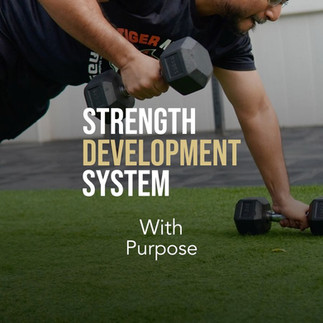



The real question is not, “Are you training hard enough?”
But rather, “Is your system applying the right strength, at the right time, in the right way?”
An efficient strength development system is not random. It is built on progressive loading, aligned with:
Your training history
Existing limitations or pain points
Long-term performance goals
If your system is missing structure, progression, or intent, you’re not building performance; you’re just accumulating fatigue.

To evaluate your system, break it down into four critical levels:
Level 1: Build the Foundation (Base Strength & Movement Quality)
Before chasing heavy lifts or complex variations, the first priority is simple:
Fix the basics.
This includes:
Fundamental movement patterns (squat, hinge, push, pull, rotate)
Joint alignment and control
Exercise selection based on individual capacity
Most people skip this stage and jump into:
Heavy loading
Machine-based training
Random program structures
Especially after periods of inactivity, this approach increases the risk of:
Poor movement mechanics, Compensation patterns, Injury exposure
A strong system always starts with:
Controlled movement → Consistent loading → Technical mastery
Without this base, everything built on top is unstable.
Level 2: Develop Dynamic Strength (Speed, Power, Control)
Traditional strength training often focuses on:
Slow, controlled reps
Isolated muscle work
Fixed movement patterns
Strength without speed is incomplete. From a performance standpoint, strength is only valuable if it can be applied quickly and efficiently. This is where Rate of Force Development (RFD) becomes critical.
Your system must include:
Speed-based drills
Power movements
Multi-joint, coordinated actions
Examples:
Explosive lifts, Plyometrics, Medicine ball work, Acceleration-based drills
The objective:
Not just to produce force, but to produce it fast, with control.
If your program lacks speed and power, it is limiting your real-world performance.
Level 3: Integrate Strength with Conditioning
One of the most common mistakes is separating Strength training & Cardiovascular fitness. This creates an incomplete system.
There is a misconception that:
“Strength training does not improve cardiovascular fitness.”
However, structured strength systems—when programmed correctly—can significantly challenge and improve:
Heart rate capacity
Work tolerance
Energy system efficiency
Training models (including high-intensity strength circuits) show that:
Strength + density-based programming
Short rest intervals
Multi-exercise sequencing
Metabolic conditioning blocks
can push the body into high-intensity (red zone) cardiovascular demand.
The goal:
Build strength that carries fitness within it.
Level 4: Define Your Direction (Speed-Dominant vs Strength-Dominant)
Every effective system has a clear direction. Without it, training becomes: Random, Reactive & Short-term focused
A structured approach follows velocity-based strength development, where training is biased toward a specific outcome:
Two Primary Pathways:
1. Speed-Dominant System
~60% speed / 40% strength
Focus: movement velocity, explosiveness, rapid force application
2. Strength-Dominant System
~60% strength / 40% speed
Focus: maximal force production, load capacity
This decision directly influences:
Load selection
Repetition ranges
Set structure
Exercise selection
Overall program design
The key is alignment:
Train according to your goal, not just your preference.
Author
ABHISHEK VASUDEVA
Sport Science Expert


Comments